
Why Does Business Need CDP?
Together with Andrew Sorokin, we reflected on CDP and its necessity.
Introduction
Today, there is a growing interest in Customer Data Platform (CDP) solutions. They are being implemented not only by large corporations, but also by representatives of medium and small businesses. In this article, we will briefly examine the key points of CDP implementation for any company with a customer base of 5,000 customer profiles or more.
What is CDP?
Customer Data Platform (CDP) is a centralized system that aggregates customer data from various sources, whether external data sources such as free Wi-Fi networks, GEO data, Bluetooth beacons, etc., or internal data sources such as data from CRM systems, loyalty programs, cash register system data, or activity on the company's website or mobile application. CDP is a powerful tool for continuous monitoring of customer assets and provides businesses with the most objective view of the results of customer interactions. The reliability and breadth of analytical data that businesses receive from CDP allows them to improve marketing strategy, increase communication efficiency, and optimize marketing costs without losing effectiveness.
1) Combining data from multiple sources
Key advantages of CDP for business
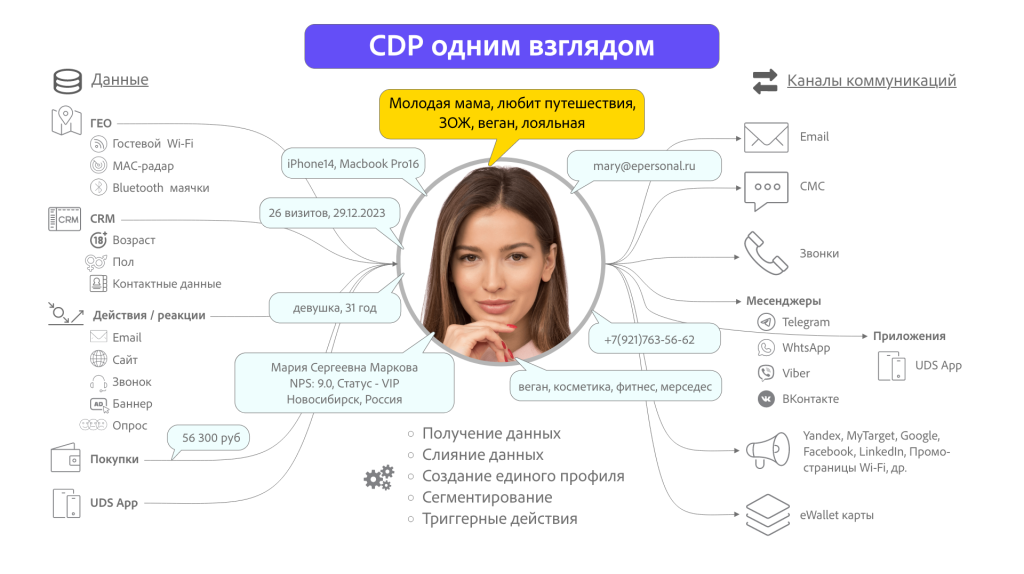
CDP integrates data from a large number of customer touchpoints, providing a holistic understanding of their behavior and preferences. This allows businesses to better manage the customer lifecycle and increase satisfaction levels.
Technological integration with data sources includes:
🟢 Guest WiFi: Collecting data on customers using the guest network to analyze their behavior and preferences.
🟢 MAC radar: Tracking devices via MAC addresses to understand customer movements.
🟢 Bluetooth beacons: Using Bluetooth beacons to obtain data on customer movements and interactions at physical locations.
🟢 JS on website: Integration with JavaScript on websites to track customer behavior online.
🟢 Telephony: Collecting data from telephone systems to analyze customer interactions through calls.
🟢 Loyalty program: Integration with loyalty programs to obtain information about purchases and preferences of regular customers.
🟢 Mobile application: Integration with the Business mobile application will allow creating a customer behavior profile based on GEO data and interaction history.
🟢 CRM: The Business's existing CRM system can become a good data source for CDP at the implementation start and during operation.
2) Customer base monitoring and revenue forecasting
Key advantages of CDP for business
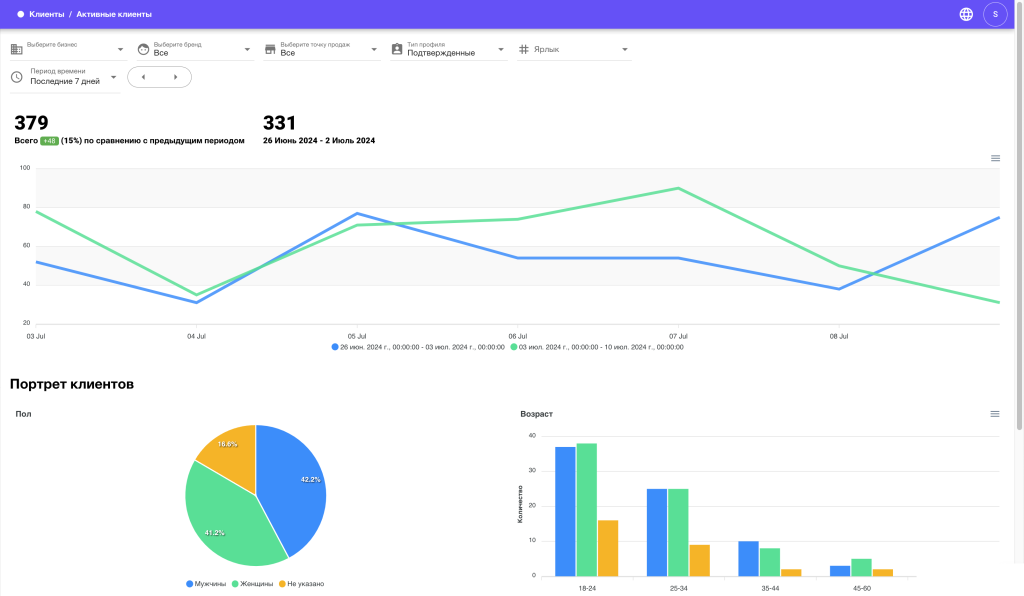
CDP provides continuous tracking of customer base status, allowing for prompt identification of problems, areas of stable business functioning, potential growth areas, and forecasting future revenues. All this is extremely important for strategic planning and company resource management.
CDP includes basic analytical reports such as:
🟠 New Customers: Reports on the number and characteristics of new customers over a specific period.
🟠 Active Customers: The report shows the structure of the customer base active during the period, from the most engaged and loyal consumers to customers with minimal activity.
🟠 Customers at risk (churn): Reports helping to identify customer segments that may stop interacting with the company.
🟠 Frequency reports: Statistics on the frequency of purchases or customer interactions with the business.
🟠 And several other standard reports
3) Control and analysis of marketing investments (ROMI)
Key advantages of CDP for business
- CDP provides managers with the ability to track key metrics and results of marketing communications in real time, respond promptly to trend changes, analyze return on investment (ROMI), and make informed decisions.
4) Customer segmentation and marketing communications through various channels
Key advantages of CDP for business
- CDP allows for effective customer base segmentation to create personalized marketing campaigns. This helps optimize advertising expenses and increase return on marketing investment (ROMI).
- Depending on available channels, you can create various campaigns, measure their effectiveness, and make decisions based on objective data rather than emotions.
- Main channels applicable for customer communications include:
🟡 SMS: Quick and direct messages for instant interaction.
🟡 Email: Mailings with detailed information, promotions, and news.
🟡 Operator calls through Call Center: Personalized calls for detailed discussion of offers and support.
🟡 Media advertising in advertising or social networks: Wide reach of target audience through visual and contextual ads.
Conclusion
CDP is a powerful tool for continuous monitoring of customer assets and provides businesses with the most objective view of customer interaction results.
The reliability and breadth of analytical data that businesses receive from CDP allows:
- Improving marketing strategy.
- Increasing communication efficiency.
- Optimizing marketing costs without losing effectiveness.
CDP implementation provides businesses with significant advantages compared to classic CRM systems: improved forecasting accuracy, increased marketing campaign effectiveness, and better customer interaction.
CDP helps companies make informed decisions based on verified data, ensuring constant control and analysis of marketing investments. This makes CDP an important tool for ensuring business sustainability and growth.
If you feel that your Business needs CDP, I have a win-win proposal with zero risks.
Write to me.